
Power of Attorney Format: General, Special, Property and NRI Samples
A power of attorney lets you appoint someone you trust to act for you when you cannot be present. Pick the right type below, read what it can and cannot do, then fill it in with the drafter and download it as Word or PDF.
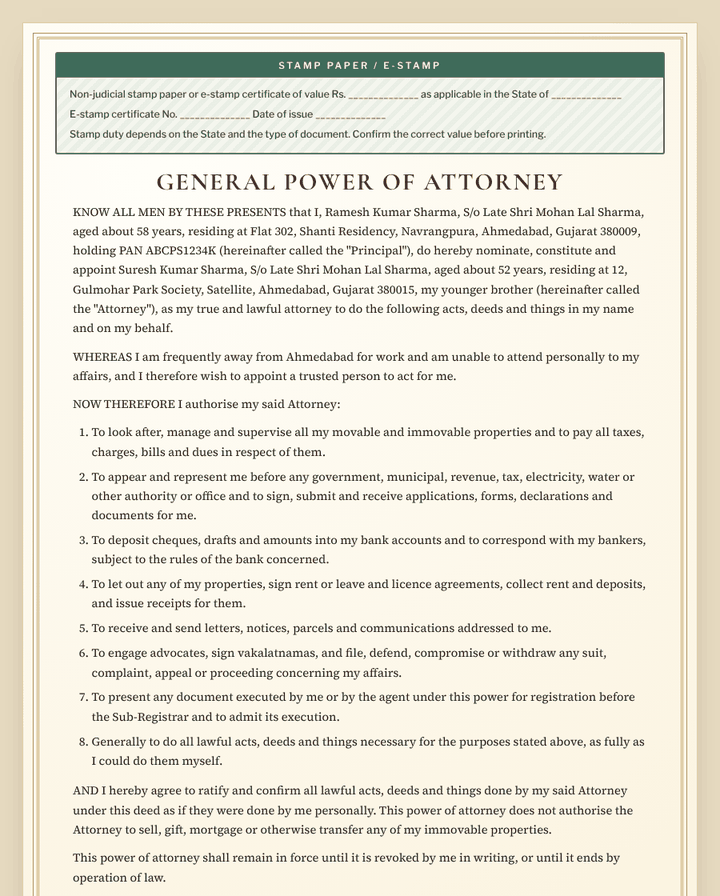
What a power of attorney is
A power of attorney (often shortened to POA, and called a mukhtarnama in Hindi and Urdu usage) is a written instrument by which one person, the principal or donor, authorises another person, the agent, attorney or donee, to act in the principal’s name. The Powers of Attorney Act, 1882 defines it broadly, in section 1A, as any instrument empowering a specified person to act for and in the name of the person executing it.
Section 2 of that Act says the agent may sign documents in their own name and signature under the authority of the power, and the act is as effective as if the principal had done it. That is why the deed must describe the powers clearly: banks, Sub-Registrars and courts read the wording closely and accept only what is written.
The relationship is also an agency under the Indian Contract Act, 1872. The principal can revoke the authority (section 203), and the agency ends on the principal’s death, unsoundness of mind or insolvency (section 201), unless the agent has an interest in the subject matter as described in section 202.
Types of power of attorney and when to use each
| Type | Use it when | Format |
|---|---|---|
| General power of attorney | You need someone to handle many routine matters for a period: offices, bills, rent, letters, cases. | General POA format |
| Special (specific) power of attorney | One task only, such as collecting documents, attending one registration or one bank matter. | Special POA format |
| Power of attorney for property | Selling, managing or letting a flat, house or land on your behalf. | Property POA format |
| Bank power of attorney | Someone must operate your bank account. Banks often prefer their own forms. | Bank POA format |
| NRI power of attorney | You live abroad and need a relative in India to act for you. | NRI POA format |
| Revocation (cancellation) | You want to withdraw an earlier power of attorney. | Revocation deed format |
| Hindi and Bangla versions | The office or the people signing prefer Hindi or Bengali. | Hindi and Bangla |
How to make a power of attorney, step by step
- Decide the scopeWrite down exactly what the agent must do. A narrow, clear list is safer than wide general words.
- Choose the agentPick an adult you trust completely. Note their full name, parentage, age, address and ID.
- Draft the deedUse the drafter or a format on this site. Tick only the powers you need; each tick becomes a numbered clause.
- Stamp itPrint on non-judicial stamp paper or with an e-stamp certificate of the value your State requires for that kind of power of attorney.
- Sign before witnessesThe principal signs, ideally with the agent accepting, before two adult witnesses who write their names and addresses.
- Notarise or registerHave it notarised, or register it at the Sub-Registrar where the law or the receiving office requires it.
Registration of a general power of attorney is generally optional under section 18 of the Registration Act, 1908. Several States have changed this for property: for example Rajasthan and Tamil Nadu amended section 17 to cover certain powers of attorney relating to immovable property, and Karnataka passed an amendment in 2025. A power of attorney used to present documents for registration must be authenticated as section 33 describes.
Read the full guide: when must a power of attorney be registered.
What a power of attorney cannot do
- It does not transfer ownership. The Supreme Court in Suraj Lamp and Industries v State of Haryana (2011) held that sale agreement, general power of attorney and will transactions do not convey title; only a registered deed of conveyance does. See GPA sale explained.
- It cannot authorise acts that the law says you must do personally, such as making your will, voting or giving evidence of facts only you know.
- It stops working when you revoke it, or on your death or loss of mental capacity, except in the limited case covered by section 202 of the Contract Act.
- Third parties may refuse it if the wording does not clearly cover the act, if it is old, or if they suspect it has been revoked.
Do
- Name the property, account or case precisely.
- Give a validity period for special powers.
- Keep the original safe and give certified copies where possible.
- Tell banks and offices in writing if you revoke it.
Do not
- Sign a blank or half-filled power of attorney.
- Give a sale power to someone just because they paid you money; use a registered sale deed instead.
- Use wide ‘all acts’ wording when you need only one task.
- Assume one State’s rule applies in another State.
All power of attorney formats on this site
General POA
Wide authority for routine affairs, with a powers checklist.
Open formatFormatSpecial POA
One task, one deed, with an end date.
Open formatFormatProperty POA
Sale or management of a flat, house or plot.
Open formatFormatBank POA
Operate a savings or current account.
Open formatFormatNRI POA
Signed abroad, attested or apostilled, stamped in India.
Open formatFormatRevocation
Cancel an earlier power and notify everyone.
Open formatFormatWord and PDF files
Editable downloads of every POA format.
Open formatFormatHindi mukhtarnama
Aam mukhtarnama format in Hindi.
Open formatFormatBangla format
Amokhtarnama format in Bengali.
Open formatFrequently asked questions
Is a power of attorney valid without registration?
Often yes. A general power of attorney is usually valid if properly stamped, signed and notarised, because registration is optional under section 18 of the Registration Act for documents not listed in section 17. Some States require registration for powers of attorney relating to immovable property, and offices such as Sub-Registrars may insist on a registered or authenticated power for certain acts.
Who can be appointed as an attorney?
Any adult of sound mind whom you trust. Family members are common choices. A company can act through an authorised person. Avoid appointing someone who has a conflict of interest in the matter.
Can I appoint two attorneys?
Yes. Say whether they must act jointly (both sign) or jointly and severally (either can act alone). Joint action is safer for property and money matters.
Does a power of attorney end when the principal dies?
Yes, as a rule the agency ends on the principal’s death under section 201 of the Indian Contract Act. Section 202 protects an agent who has an interest in the property that is the subject of the agency.
How much stamp duty is payable on a power of attorney?
It depends on the State and on the type of power, for example general, special, or one authorising sale of property. Check your State’s stamp duty schedule or e-stamp portal; every format on this site leaves the stamp value blank on purpose.
Can a power of attorney holder sell my property?
Only if the deed clearly gives that power, and the sale must still be made by a registered sale deed. The power of attorney itself does not make the agent the owner.
Please note: these templates are for general information and are not legal advice. Laws, stamp duty, notarisation and registration rules vary by State. Consult an advocate for your case. This is an independent website, not a law firm and not a government office.